Case study
Transforming a multi brand design system
How we transformed Liberty Group’s simple set of libraries into a multi-brand design system for greater efficiency and consistency
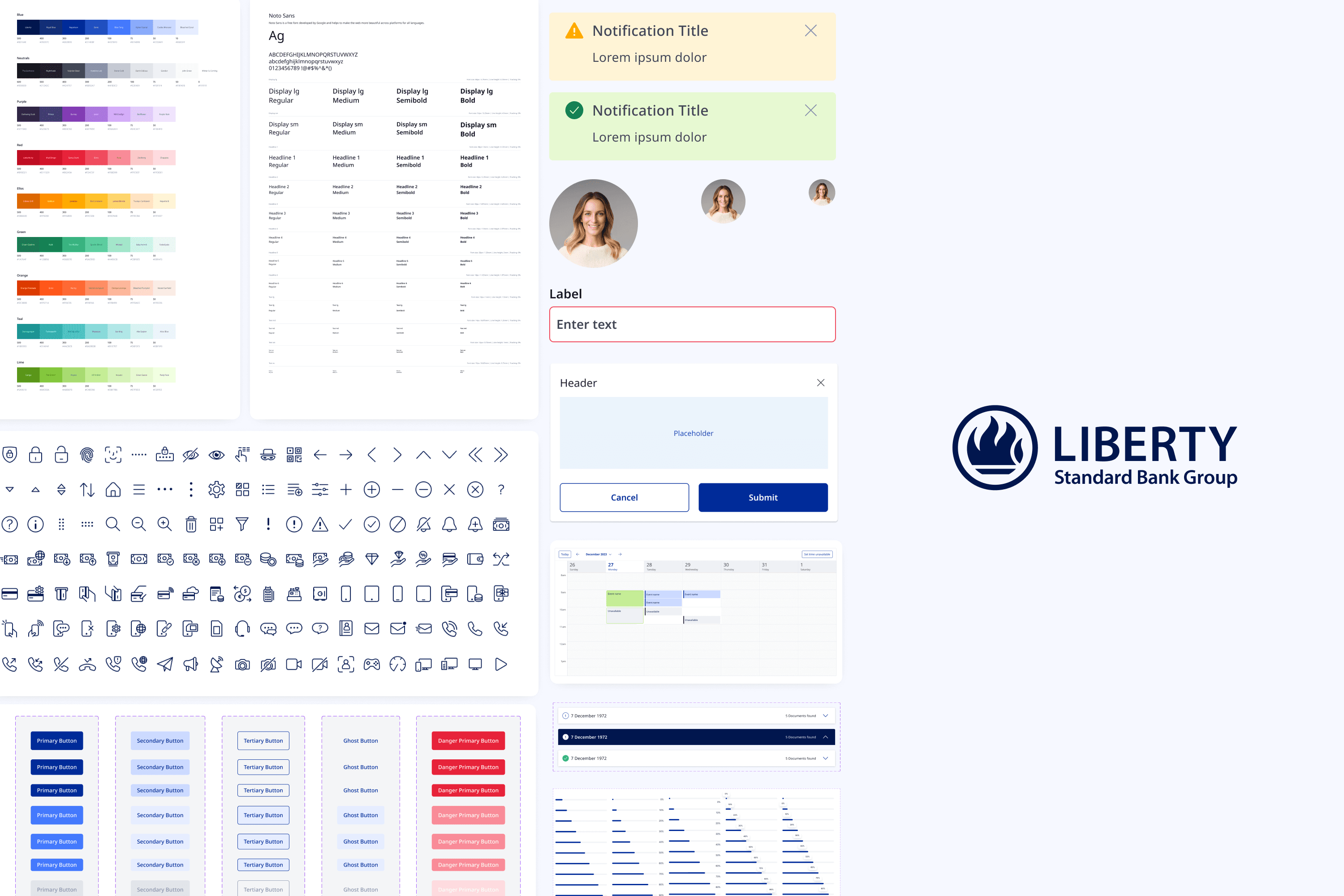
About the company
Liberty Group, a leading South African financial services provider(a division of Standard Bank). Liberty offers diverse products, including life, health, and motor insurance.
company
Liberty Group
location
South Africa
industry
Insurance, Fintech
audience
Developers, Internal stakeholders, Clients
Platform
Web
Year
2023-2024
duration
12 months
The company
Liberty is a leading South African financial services provider, a division of the Standard Bank Group, specialising in insurance and investment solutions.
Project context
Liberty's parent organisation (Standard Bank Group) was undergoing expansion and restructuring. This transformation necessitated the adoption of new brands, culture, and strategic thinking.
Liberty needed a unified design system to streamline product development across its multiple brands (Liberty, Stanlib, Liberty Health) and platforms (web, mobile, internal tools), while maintaining brand consistency and improving user experience.
The challenge
Liberty was undergoing expansion and restructuring. While an existing design system was in place, it was plagued with numerous challenges that led to a disjointed user experience, inefficient workflows, and increased design and technical debt.
High development cost
The cost of designing, developing, and shipping new products was significantly high due to inconsistencies and redundant work.
Fragmented components
Existing components were inconsistent across teams and brands, with more than 54 different button variations alone.
Poor governance
Lack of ownership model or contribution process for the design system, leading to organic but chaotic growth.
Brand dilution
No clear guidelines to balance corporate brand consistency with sub-brand customisation needs.
Limited accessibility
Components didn't meet WCAG standards, creating compliance risks and excluding users with disabilities.
Low adoption rate
Developers and designers avoided the existing system due to outdated documentation and poor usability.
The goal
Our main goal was to redesign the existing design libraries and brand knowledge into a robust Liberty Design System (LDS) - a flexible, accessible, and future-proof foundation that would seamlessly integrate across multiple digital brands and platforms.
Other goals included:
Create a single source of truth for designers, developers, and product teams
Enable cross-brand consistency while allowing controlled customisation
Improve accessibility compliance to meet WCAG 2.1 AA standards
Reduce design and development time by 30-40%
Establish sustainable governance for long-term scalability
Develop comprehensive documentation and design patterns
Provide seamless experience for developers and designers
Enhance consistency and efficiency across all digital products
Team & Stakeholders
Collaborative approach
This project required close collaboration across multiple departments and stakeholders to ensure alignment with business objectives and technical constraints.
Core team (Experience Design Team)
Team Lead
Product Manager
Senior UX/UI Designer (myself)
Senior UX Designers (3)
Key stakeholders
Business Team Heads
Developers
Designers
My role
As a Senior UX/UI Designer, I was tasked with the strategic objective and responsibility of redesigning and maintaining the design system, working closely with cross-functional teams to ensure successful adoption.
My responsibilities were:
Creating and managing components
Managing design system scope and strategic direction
Collaborating with product teams to define roadmap and backlog
Supporting designers with design system related queries and training
Conducting necessary user research and usability testing
Monitoring design system delivery and adoption metrics
Conducting design system ideation workshops and showcases
© 2025 Mandla Nkala. All rights reserved.
All trademarks, product names and logos on this site are property of their respective owners.