Case study
Redesigning funeral insurance digital onboarding
How I redesigned Hollard’s funeral insurance onboarding to enhance time to value and user experience for retail insurance clients
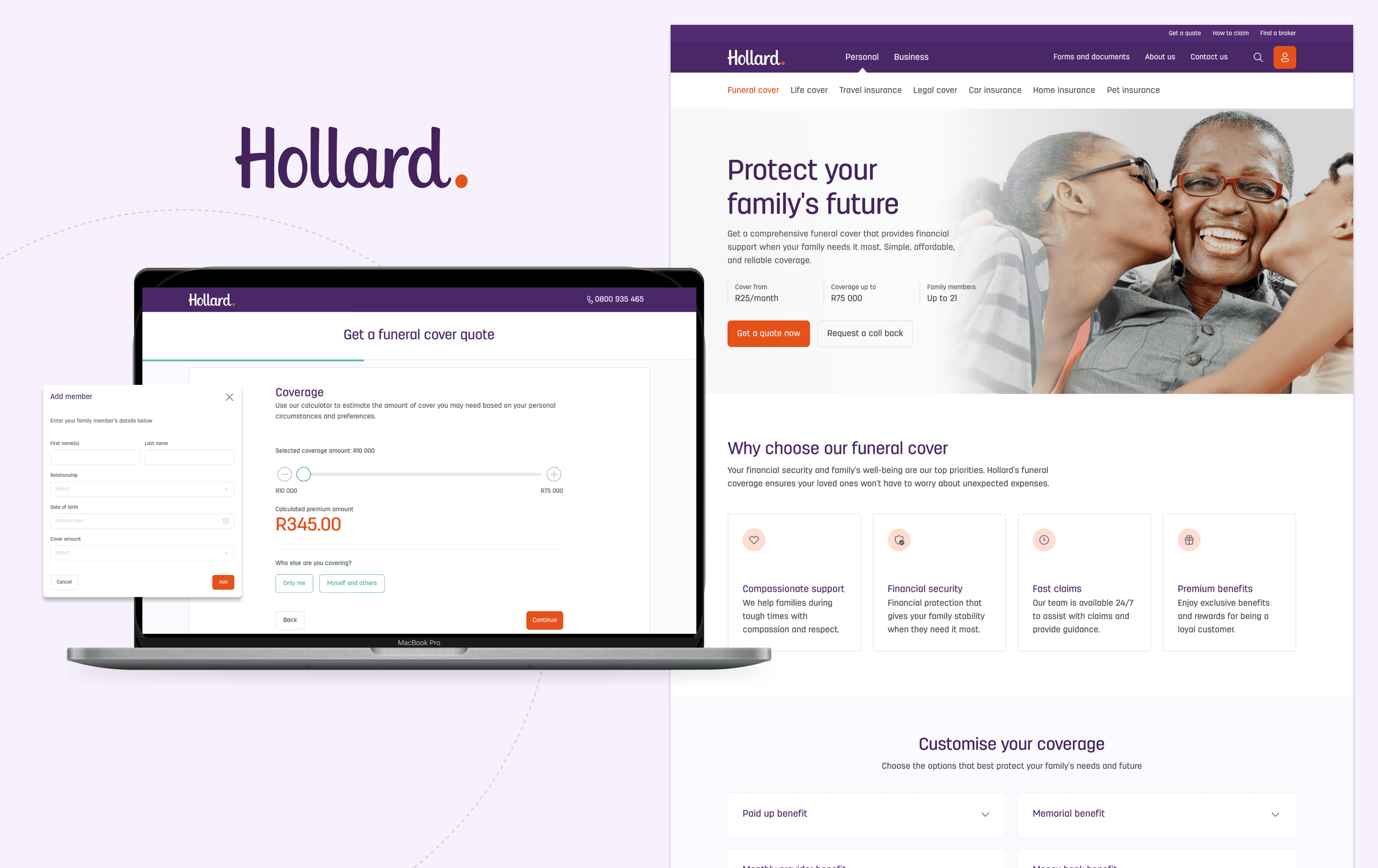
About the company
Hollard Insurance is the largest independent and privately owned insurance company in South Africa with operations in multiple African countries. The company‘s product portfolio is primarily divided into two main categories: short-term insurance and life insurance.
company
Hollard Insurance
location
South Africa
industry
Insurance, Fintech
audience
Retail insurance clients
Platform
Web
Year
2019-2020
duration
6 months
team
The team and my role
This project was fulfilled through a close collaboration across multiple departments and stakeholders to ensure alignment with business objectives and technical constraints.
Core team
Senior UX/UI Designer (myself)
Product Manager
Frontend Developers (3)
Backend Developers(4)
Business Analyst
Key stakeholders
Business
Actuaries
Marketing
Sales
Customer service
Legal
Compliance
My role
As a Senior UX/UI Designer I was responsible for designing digital experiences, growing the design capability and evangelising design within the company. In this project, I
Conducted in-depth analysis of the existing user designs, pinpointing the inefficiencies at both UX and UI levels to strategise solutions.
Conducted interviews with the internal teams, users, and listened to customer calls to gather insights into the current system’s inner workings.
Collaborated with managers, developers, analysts, actuaries, and marketing to ensure that the design aligns with Hollard’s business goals and objectives as well as Hollard’s overall design strategy.
Led the redesign of the new quote-buy web application, and collaborated with the central design team to ensure that this update was seamlessly integrated into our design system, enhancing brand consistency across the platform.
The challenge
Hollard's life insurance division needed to replace its underperforming funeral insurance platform (v4) with a more competitive version (v5) after analysis revealed that a complex application process was causing high abandonment rates and declining policy purchases, resulting in significant lost premium revenue.
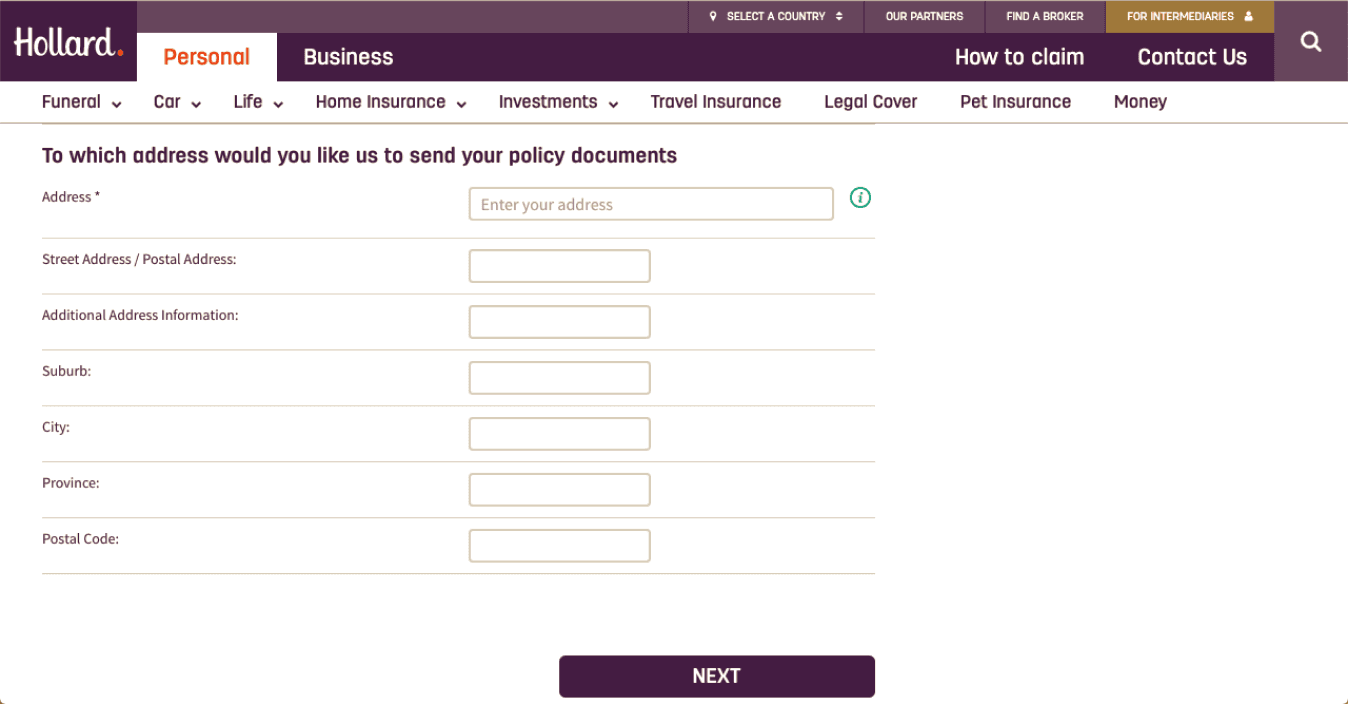
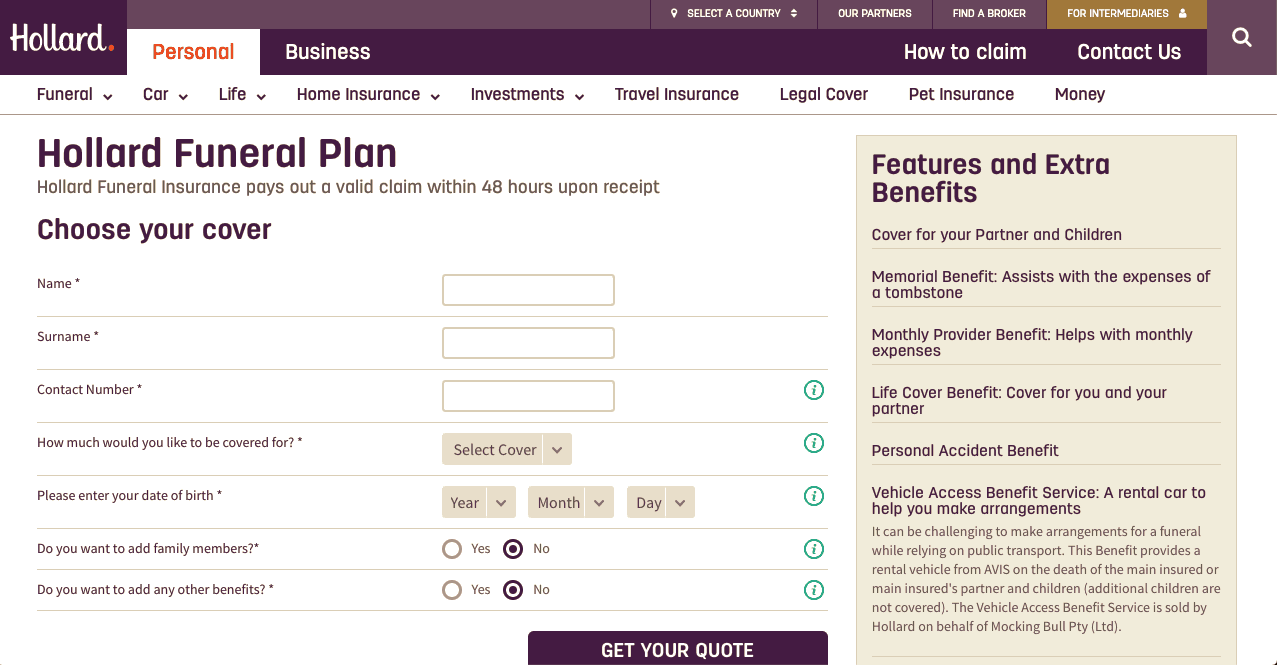
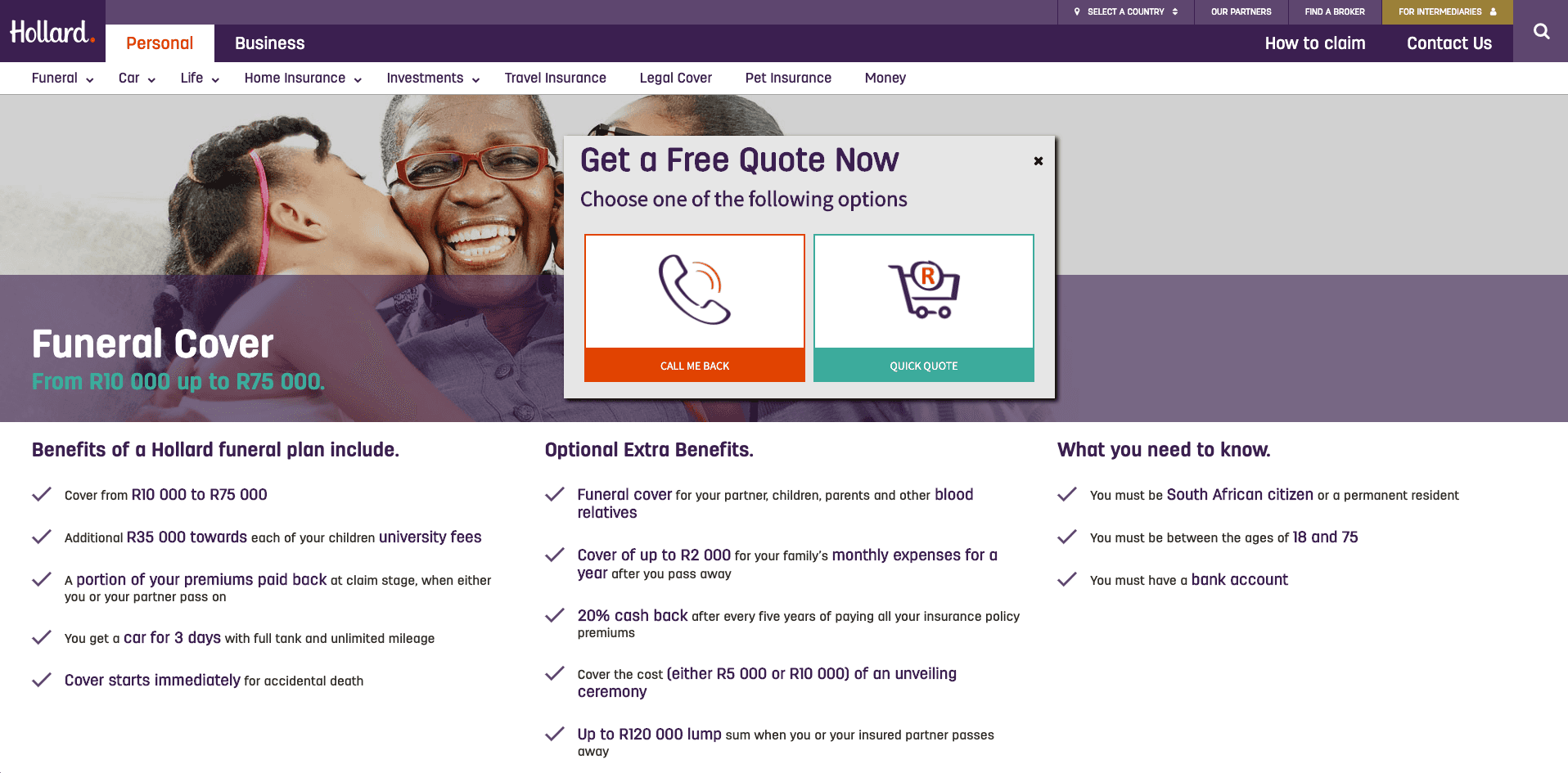
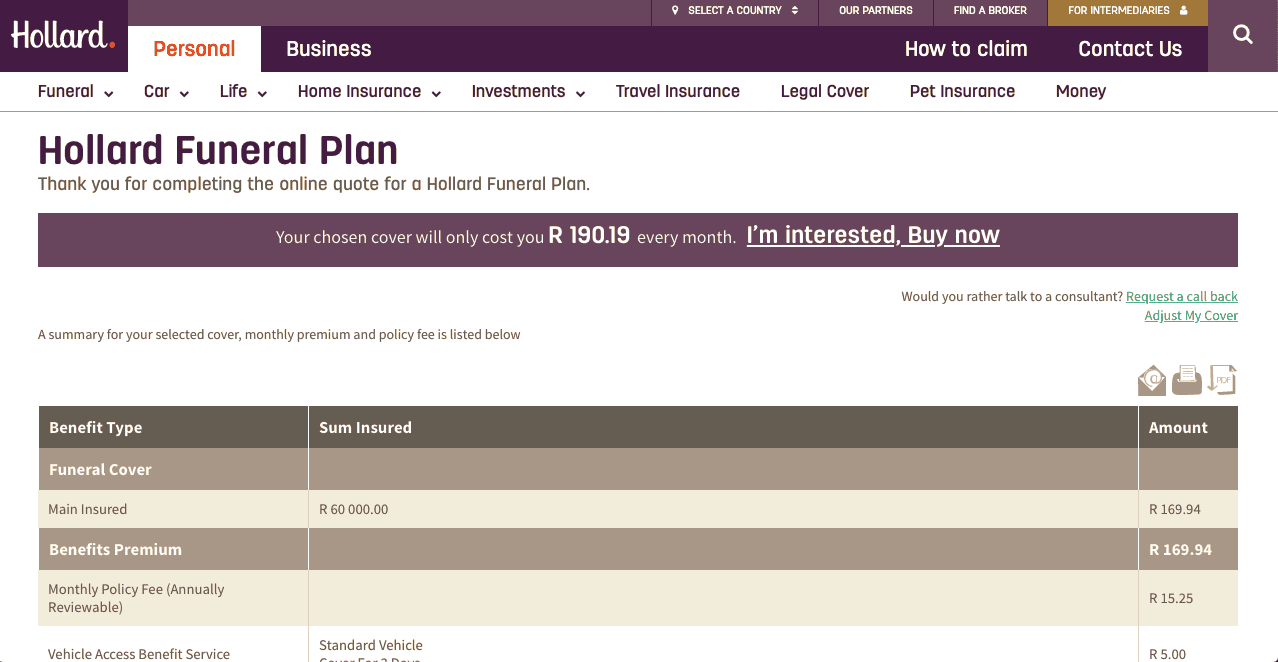
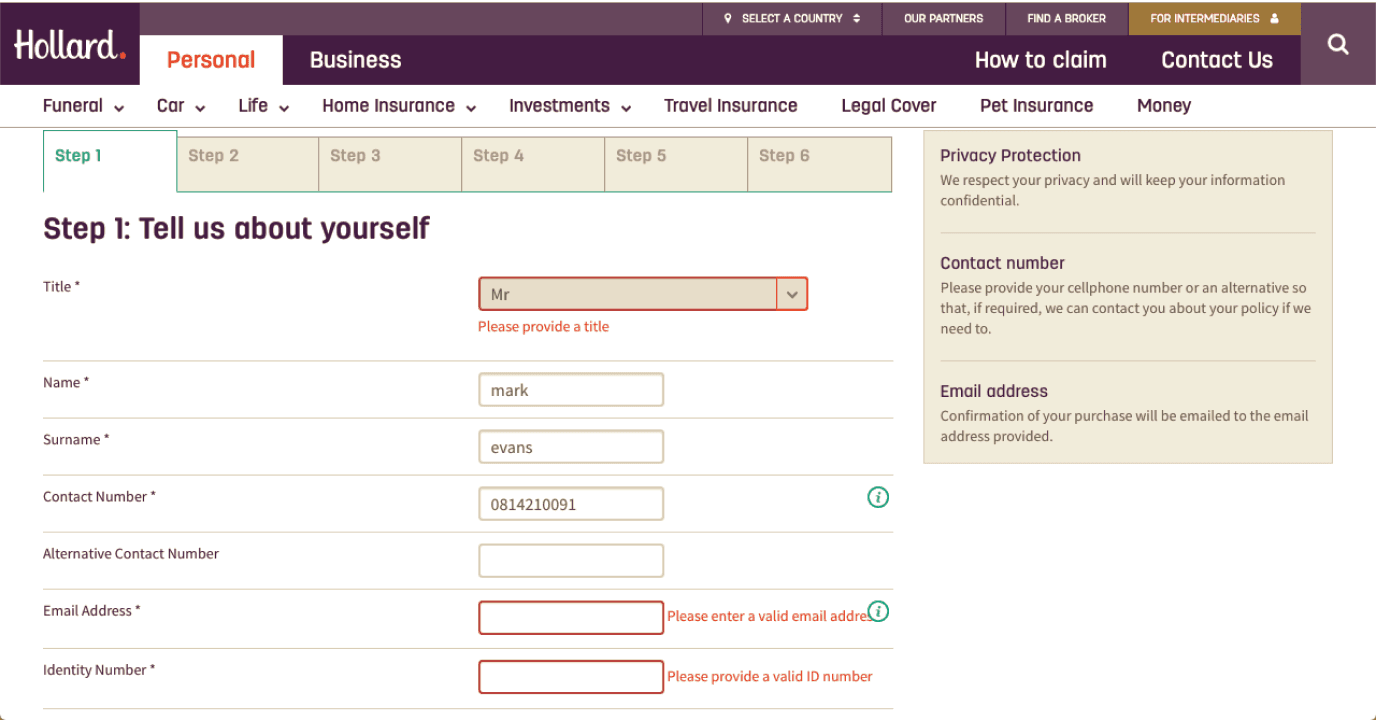
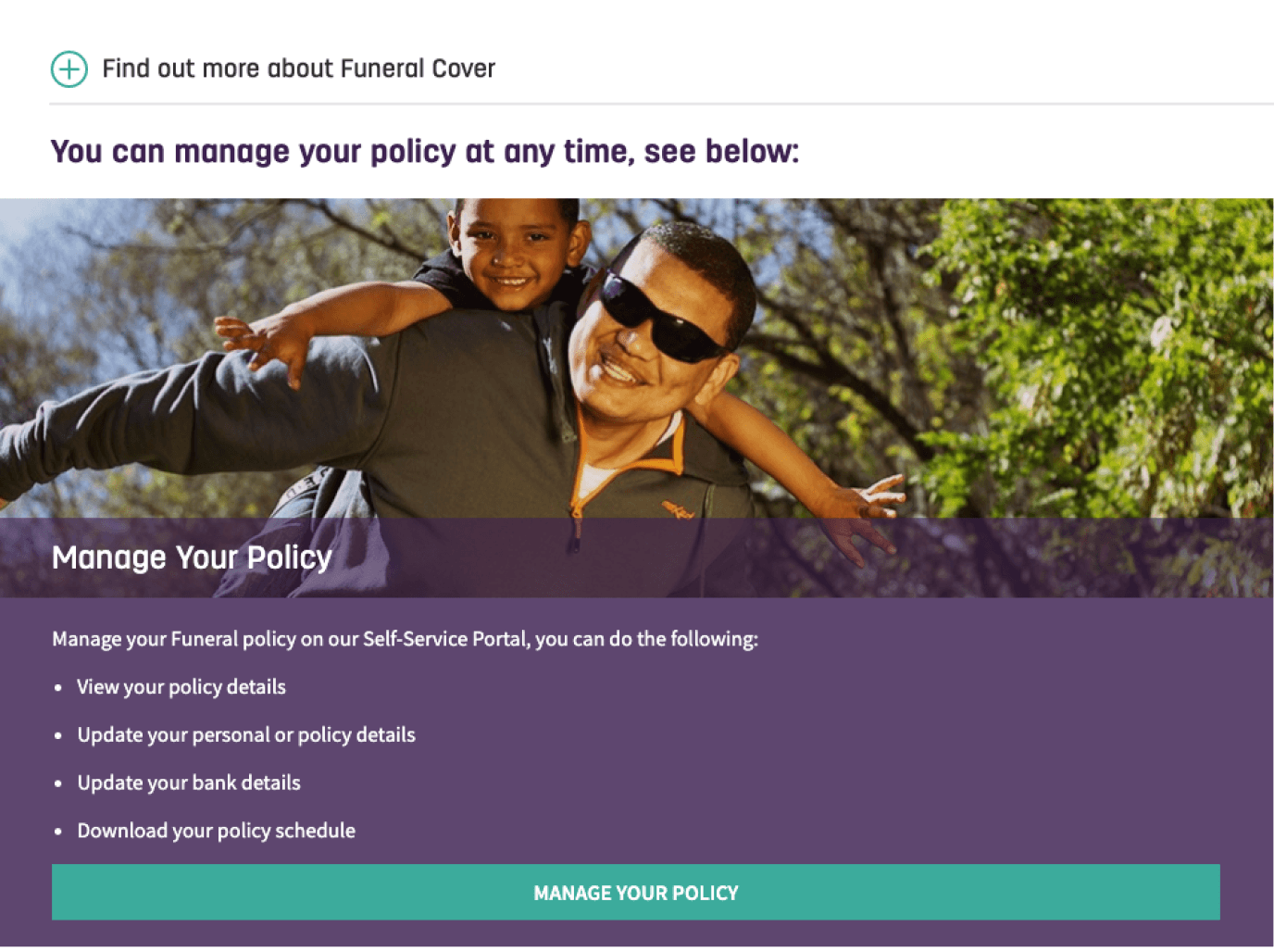
Some screenshots from the old version
Goal
Our goal was to empower a diverse South African audience to self-serve online for funeral policies by focusing on empathy, accessibility, and simplicity while adhering to critical business requirements.
Reduce abandonment rates throughout the quote-and-buy process
Increase completed purchases and conversion rates
Improve customer satisfaction and trust in the platform
Lower operational costs through improved self-service
Maintain market competitiveness in the digital insurance space
The outcome
We successfully redesigned Hollard's life insurance quote and buy features for web and kiosk platforms, enhancing the self-service experience. This drove increased sales and established a foundation for future product launches.
10x
Increase in post launch user growth
45%
Increased purchase conversion
12%
Increased sales growth
30%
Decreased task completion time
Solution highlights
Key features implemented were:
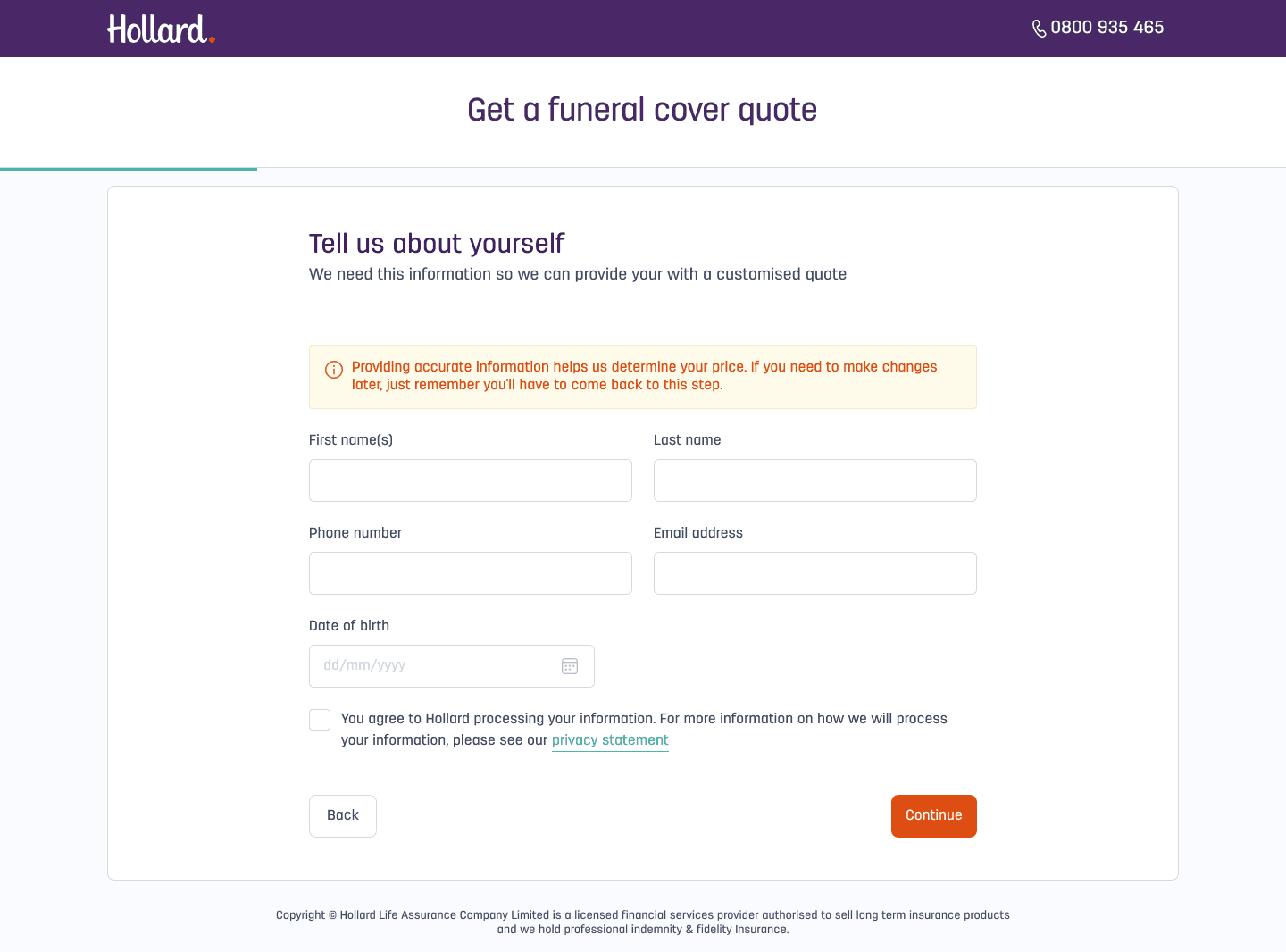
Quote generation
We introduced a feature to generate a personalised quote upfront, ensuring transparency and setting expectations before committing to purchase.
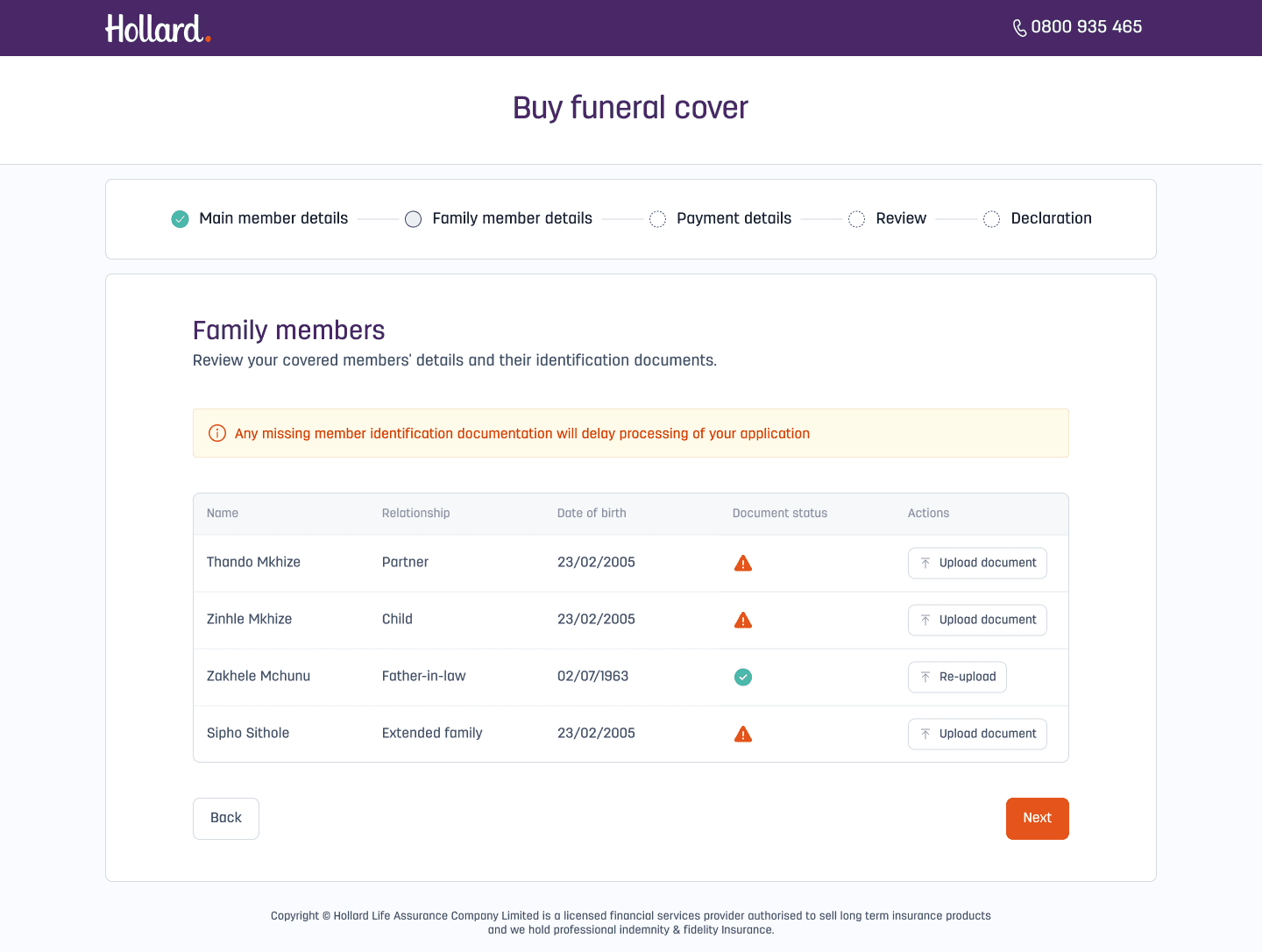
Guided application flow
We revamped the application process to a 4-step process with progress tracking: Main member details, Beneficiary information, Payment Information, and Confirmation.
Improved information capturing
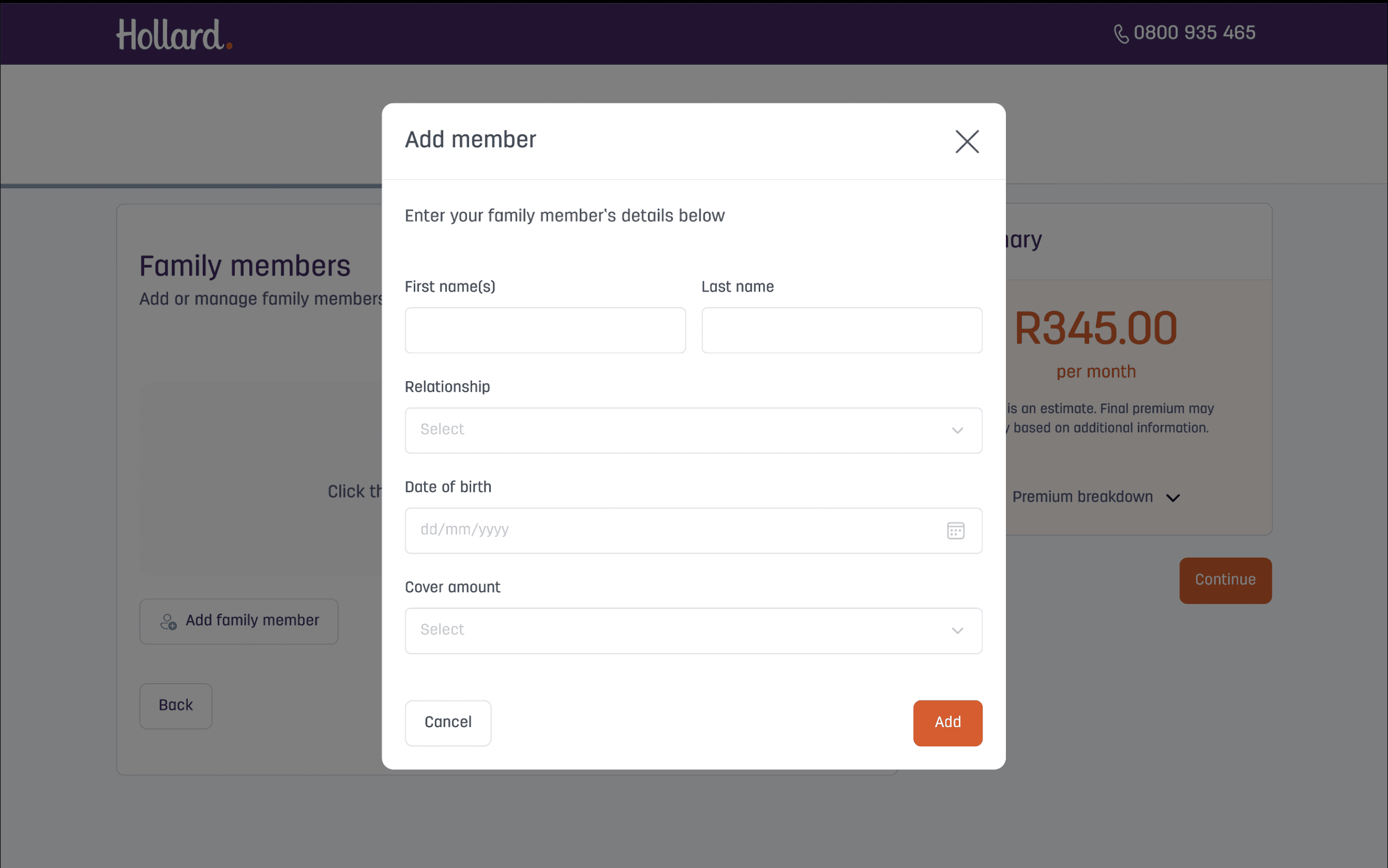
We revamped how users enter beneficiary information to reduce cognitive load through progressive disclosure. Only essential fields were shown initially with optional advanced fields collapsed by default.
process
Design approach - How we got to the solution
The digital team employed an agile methodology, incorporating essential scrum ceremonies. Our design approach was constituted of the following 4 pillar model:
Discover
Research, explore and understand
Define
Focus on insights and define the opportunity
Create
Explore and validate potential solutions and ideas
Deliver
Build solutions, test them and refine
Discovery & Analysis
From ambiguity to clarity
Through a comprehensive discovery phase, I gathered insights from stakeholders, evaluated existing usability patterns, and analysed existing data and competitors to uncover opportunities that would bridge user needs with business objectives.
Understanding the landscape, stakeholders, and competitors
I employed multiple research methods to gain comprehensive insights into the current landscape, business requirements, and technical enablements and constraints. I gathered feedback, studied competitor products, and identified common problems.
Research activities and methodologies:
Stakeholder interviews
Gathered insights into business objectives and scalability requirements to ensure alignment with long-term goals.
Heuristic evaluation analysis
Evaluated the current product’s usability and navigation structure to identify inconsistencies, usability issues, and areas for improvement.
Competitive analysis
Researched similar apps and services to uncover industry trends, best practices, and differentiation opportunities.
Analytics review
Analysed customer support calls and site analytics to identify common pain points
Understanding user needs and behaviours
Through feedback from testing the existing application, customer service call recordings and support ticket analysis, we identified critical user frustrations we discovered a number of pain points and barriers to completion.
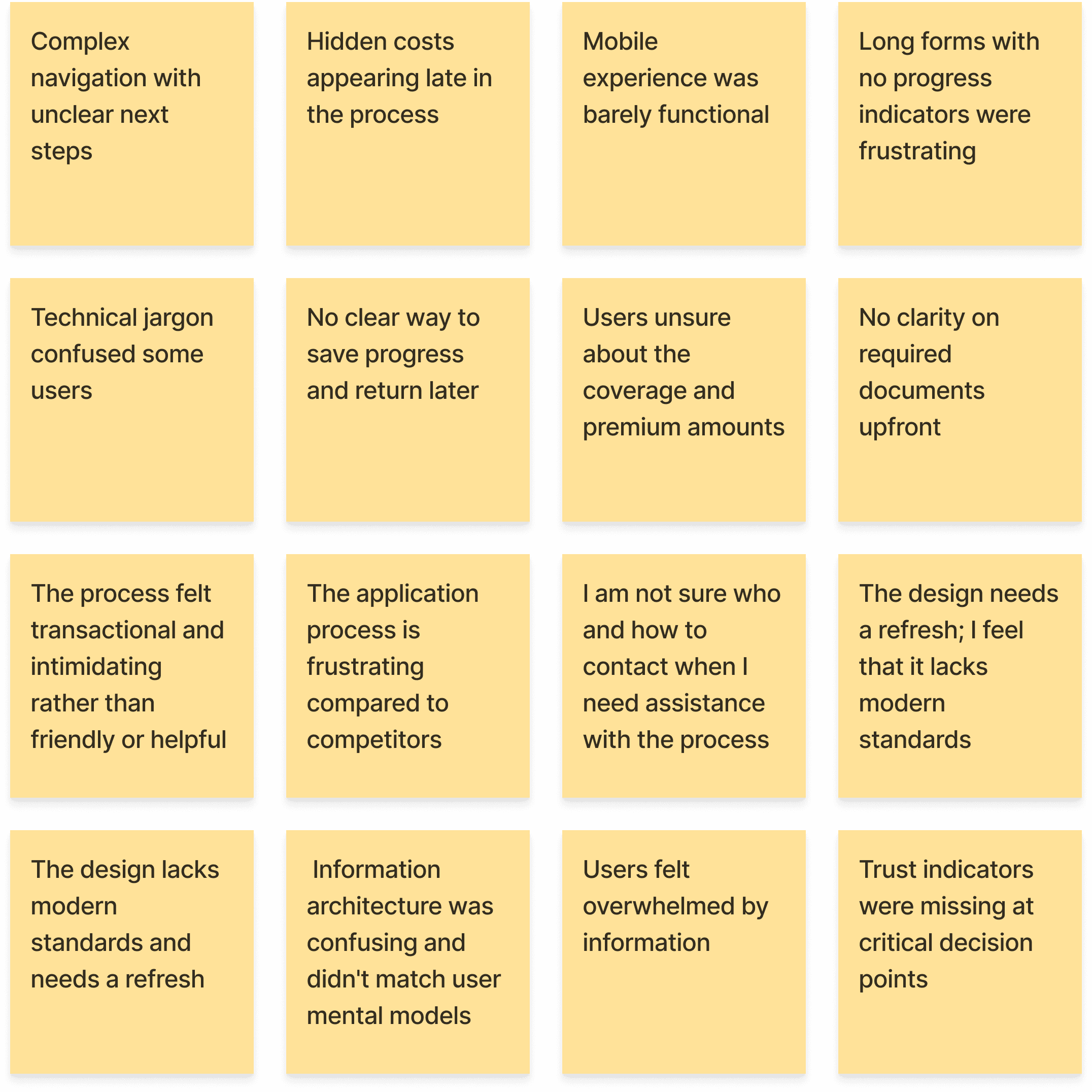
Some findings from the discovery phase
Delivery & Handoff
Seamless transition from design to development
We delivered detailed documentation and design annotations to support the development team, including guidance on micro-interactions, animations, and responsive behaviour.
A typical delivery package provided to the development team included:
Finalised Sketch design files.
Links to interactive InVision prototypes.
A complete style guide and UI kit with usage guidelines.
Responsive design specifications for all breakpoints.
Asset optimisation and export guidelines.
Zeplin links for all design flows.
the results
Measurable impact and outcomes
This project solidified Hollard as a digital leader in South Africa's insurance market and created a scalable foundation for future product launches. The redesigned platform exceeded all success metrics, delivering significant improvements in user experience, conversion rates, and business outcomes.
Business impact
25x
Increase in user growth
30%
Reduction in completion time
45%
Quote-to-purchase conversion
10%
Increase in sales post launch
User experience Improvements
Improved user experience - The new system educated and supported users, reducing support calls to the call centre.
Reduced task time - The time required to complete the process was significantly shortened
Stakeholder approval - The journey received approval from various internal teams
Enhanced comprehension - Achieved a 90% comprehension rate during user testing
Reduced form abandonment - Progressive disclosure and step-by-step flows cut form errors by 25%.
Challenges and solutions
This project presented several significant challenges. Here is an overview of the key obstacles I faced and the solutions I implemented to overcome them.
Problem
Inflexible APIs - The design of certain backend APIs imposed constraints on our options for the user interface and experience.
Solution
I worked closely with developers to manage trade offs and compromises to manage API limitations and tech debt.
Problem
Balancing compliance with simplicity - We needed to collect detailed beneficiary data for underwriting without creating a complex form that would overwhelm users.
Solution
For compliance needs - To keep the interface clean, I embedded mandatory legal disclosures into tidy, collapsible sections.
Problem
Establishing trust in data security - Users were naturally hesitant to share sensitive personal information, such as ID numbers.
Solution
I built user confidence by adding inline assurances at the point of data collection.
Problem
Very long forms requiring a lot of mandatory information
Solution
For user-friendly forms - I broke down long forms into digestible steps, used plain-language labels, and provided clear contextual cues.
Key learnings
This project provided me valuable learnings, particularly in the complex insurance domain:
Alignment
Securing stakeholder alignment early in the process prevents costly redesigns later.
Empathy
Insurance products require extra attention to building trust and transparency with users.
Simplicity
Using plain language and providing clear explanations dramatically improves form completion.
Transparency
Presenting a mandatory quote early built trust by allowing users to see pricing before committing to a lengthy form.
Progressive disclosure
Revealing information step-by-step - is highly effective at reducing cognitive load in complex forms.
Future opportunities
To enhance the user experience and streamline our digital platform, we will introduce a "save" functionality that allows users to seamlessly return to incomplete applications, complemented by an integrated chatbot for real-time assistance throughout the process; furthermore, the onboarding experience will be directly linked to the policy management portal, and upon completion, users will receive personalised product recommendations generated from their user profile.
Thanks for reading
© 2025 Mandla Nkala. All rights reserved.
All trademarks, product names and logos on this site are property of their respective owners.